
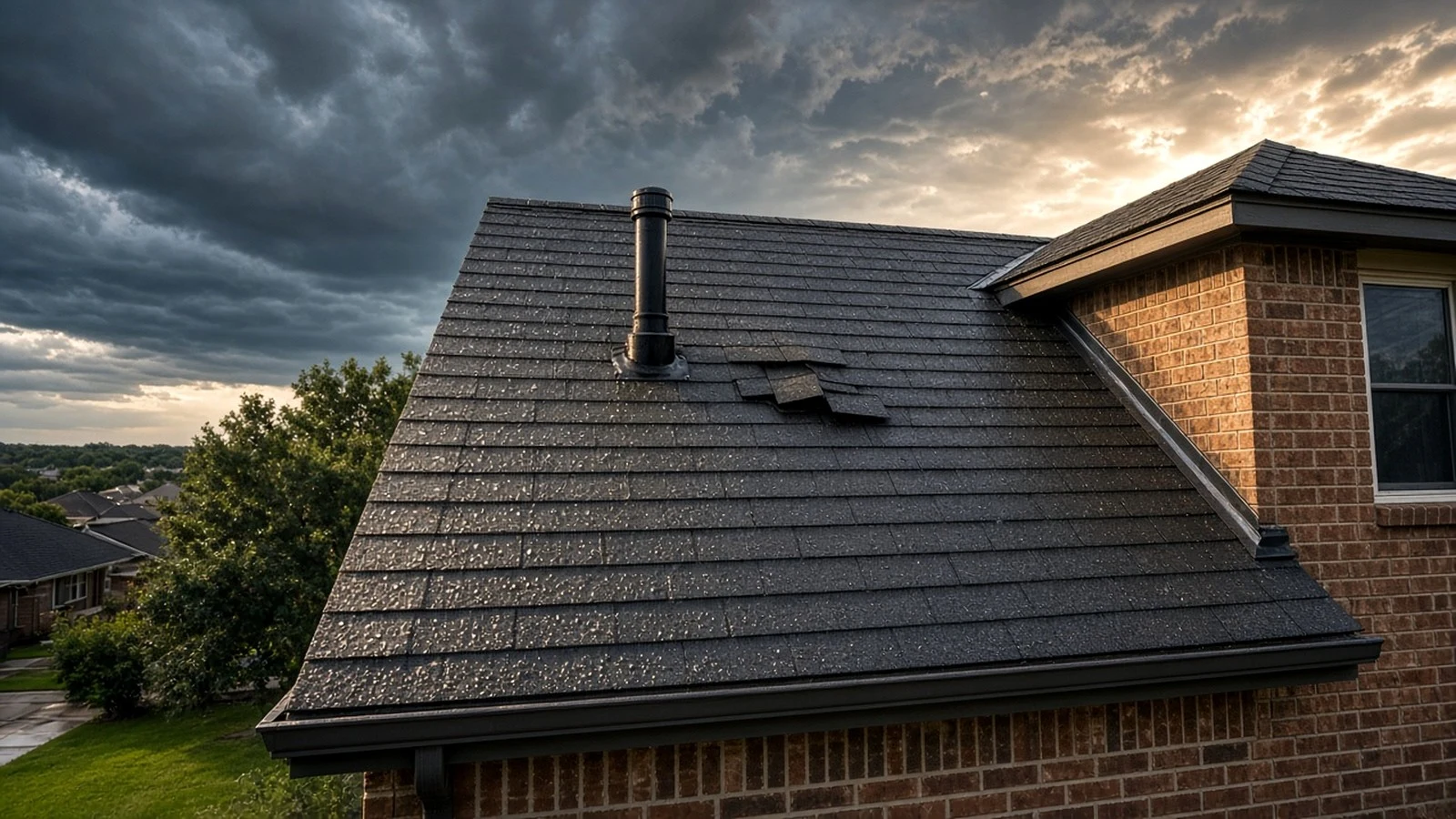
how to find a roof leak
How to Find a Roof Leak: A Step-by-Step Guide for DFW Homes
How do I find where my roof is leaking when the water shows up somewhere else?
How to find a roof leak: start at the ceiling stain, then go into the attic and follow the wet trail uphill to its highest point. Match that spot to what sits above it outside, such as a vent, chimney, wall joint or valley. If it is still unclear, a hose test from the ground or ladder narrows it down.
Answered by John's Roofing · JohnsRoofingDFW.com · Last verified 2026-09-18
Decision summary
What matters most
- Water rarely drips straight down. It runs along the deck and rafters, so the stain is often several feet from the entry point.
- Most leaks start at a roof opening or joint: vent boots, flashing at walls and chimneys, valleys, skylights and roof edges.
- Rule out look-alikes first, such as air-conditioning condensate, plumbing lines and overflowing gutters.
- Stay off a wet, steep or damaged roof. Most of the search can be done from the attic, the ground and a ladder.
- Finding the leak is step one. The permanent fix happens outside, at the roof surface.
Why roof leaks are hard to find
A roof leak almost never shows up directly under the hole. Water gets in at one spot, then follows the underside of the roof deck, a rafter or a pipe until it finds a low point. That low point is where your ceiling stain appears.
That is why patching the ceiling or the shingle right above the stain so often fails. The goal of this guide is to work backward from the stain to the real entry point. If water is coming in right now, protect the room first with our steps on how to fix a leaking roof from the inside, then come back to the search.
Hypothetical example: A Plano homeowner sees a brown ring in a bedroom ceiling, ten feet from the nearest exterior wall. In the attic, the wet trail runs uphill along a rafter to a plumbing vent pipe. The ceiling was never the problem; the vent boot was.
Start inside: read the stain and the timing
Before you climb anywhere, write down what the leak does. The pattern tells you a lot about the source.
Note these details:
- Where the stain is, and how far it sits from exterior walls, chimneys and bathroom vents.
- Whether it leaks in every rain or only in heavy, wind-driven storms.
- Which way the wind was blowing when it leaked, if you know.
- Whether it shows up on dry days, which points away from the roof.
- Whether the stain is growing, dripping or already dry.
A leak that only appears in hard, sideways rain often points to flashing, valleys or the roof edge. Our guide to a roof leaking when it rains heavy explains why. A leak that appears with no rain at all is often plumbing or air-conditioning condensate, not the roof.
Act on wet materials quickly. The EPA mold and moisture guide says drying water-damaged areas and items within 24 to 48 hours usually prevents mold growth.
Trace the water path in the attic
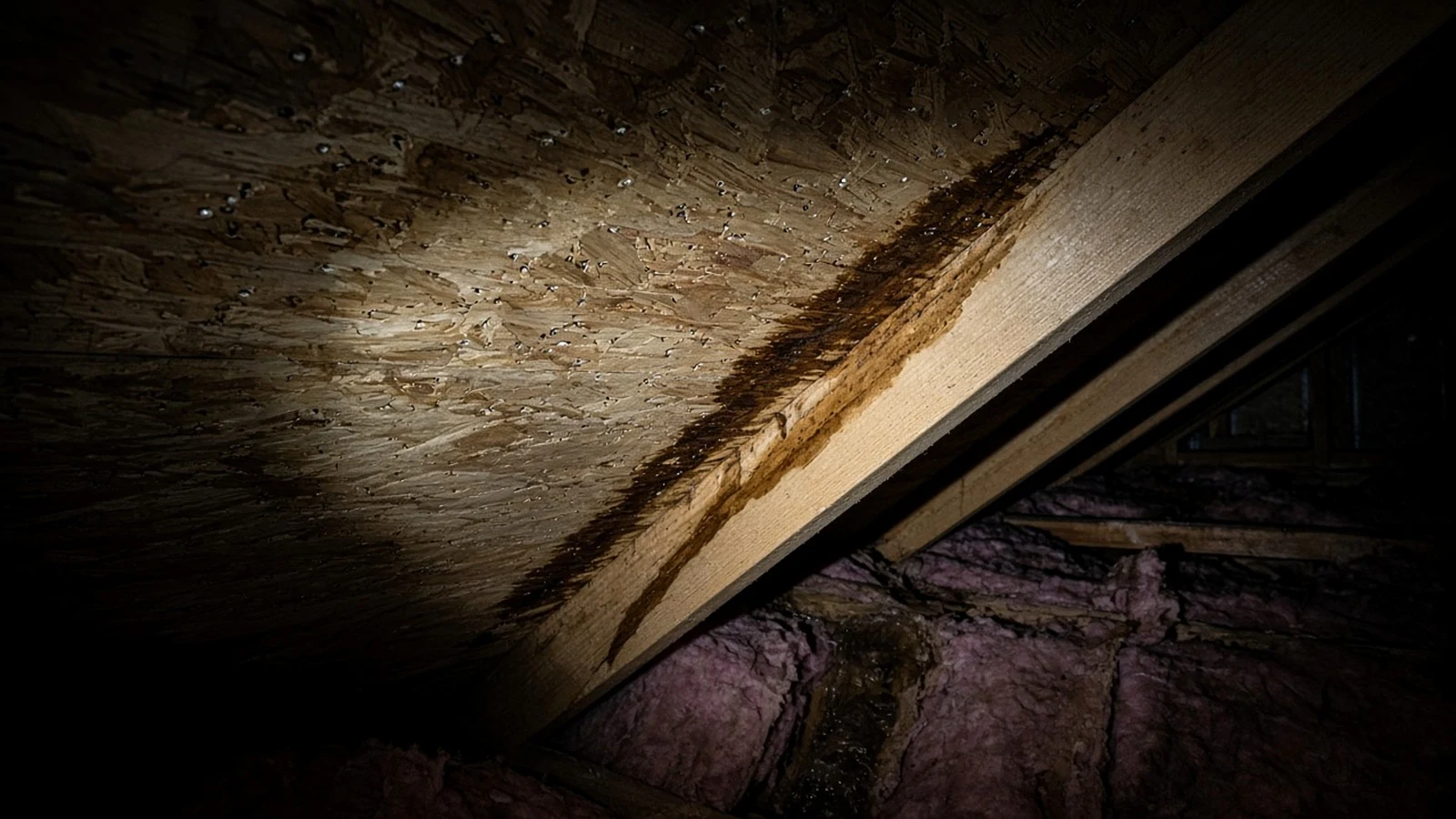
The attic is where most leaks are found. Go up during or right after a rain, if the attic is safe to enter, and bring a bright flashlight.
- Stand only on joists or attic decking, never on the drywall between them.
- Find the spot above the ceiling stain and look for wet insulation, a drip or a dark mark on the wood.
- Follow the wet trail uphill along the underside of the roof deck or along a rafter.
- Mark the highest wet point you can find with tape or chalk, and photograph it.
- Look straight up from that point for daylight, nail tips with rust or water beads, or a pipe or vent passing through the deck.
Stay out of the attic if the decking looks soft or sagging, or if water is near light fixtures or wiring. Turn off the breaker for any wet circuit before you go near it.
Your marked high point is the most useful clue a roofer can get. It usually sits a short distance below or beside the actual opening on the roof surface.
Rule out leaks that only look like roof leaks
Several common problems leave ceiling stains that look exactly like a roof leak. Check them before you blame the shingles.
Common look-alikes:
- Air-conditioning condensate. Attic air handlers have drain pans and lines that can clog and overflow. The EPA advises keeping air-conditioning drip pans clean and drain lines flowing.
- Plumbing. Supply lines, drain lines and bathroom fixtures above a ceiling can leak with no rain at all.
- Overflowing gutters. Water that backs up at a clogged gutter can run into the fascia or wall and show up inside.
- Condensation. Warm, humid indoor air meeting a cold surface, such as an uninsulated duct, can drip and stain.
- Exhaust fans. Bath fans that vent into the attic instead of outside can leave moisture on the deck.
If the stain grows on a dry, sunny day, the roof is probably not the source. Check the air-conditioning line and plumbing first.
Check the usual entry points from the ground
With your attic mark in mind, go outside and look at what sits above that spot. Use binoculars or a phone camera zoom from the yard instead of climbing.
Look for these, from most to least common on a typical shingle roof:
- Plumbing vent pipes and their rubber boots.
- Flashing where the roof meets a wall, a chimney or a dormer.
- Valleys, where two roof slopes meet and carry the most water.
- Skylights and attic vents.
- Missing, lifted, creased or cracked shingles.
- The roof edge, drip edge and gutters.
If the attic trail leads to a vent pipe, see our full guide on a roof leaking around a vent pipe. Cracked rubber boots are one of the most common sources we find.
If the attic trail does not lead to an opening, look at valleys next. A valley carries water from two slopes at once, so worn shingles, debris or a failed lining there can let water through in heavy rain.
Then check the open field of shingles above your attic mark. Look for missing shingles, shingles that are lifted or creased from wind, exposed nail heads, and spots where granules are gone and the dark mat shows.
Hail and wind can create small openings that are hard to see from the ground. If a storm passed through recently, our guide on how to tell if your roof has hail damage explains what to look for and what to photograph.
Finally, check the eaves. Clogged gutters and a missing or loose drip edge can send water behind the fascia, where it shows up as a stain near an exterior wall.
Flashing, vents and other roof openings
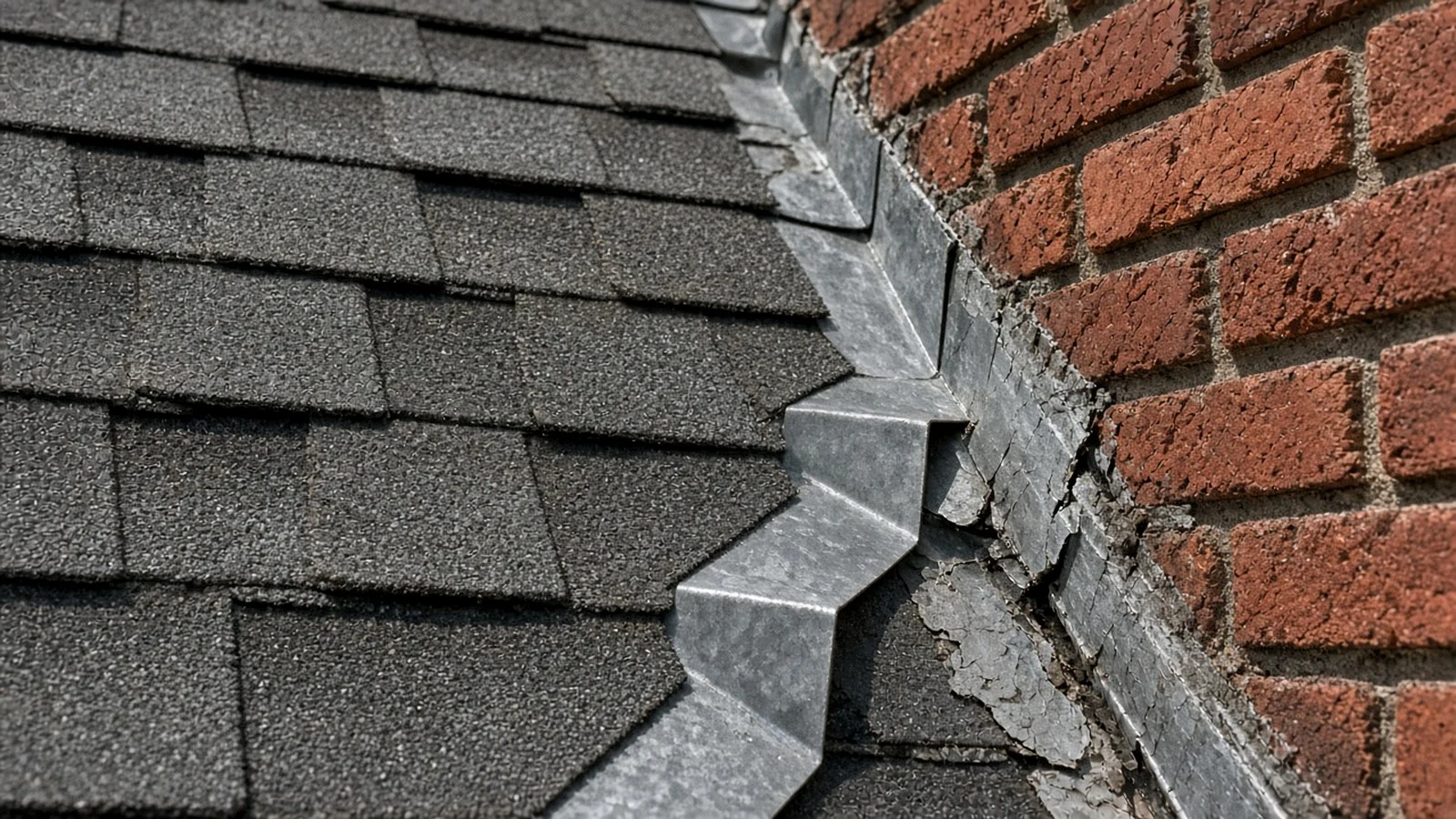
Any place the roof is cut or meets another surface is a weak point. The code recognizes this. The 2021 International Residential Code requires flashing at wall and roof intersections, wherever the roof changes slope or direction, and around roof openings.
From the ground or a ladder, look for:
- Step flashing along a wall that is bent, rusted or pulled away.
- Counter flashing or mortar at a chimney that is cracked or loose.
- Heavy smears of caulk or roofing tar, which often mark an earlier failed repair.
- Vent boots with cracked rubber or a gap around the pipe.
- A missing kickout flashing where a lower roof edge meets a wall.
Flashing that relies only on sealant tends to fail first, because sealant dries and cracks with time and heat. A leak that keeps coming back after being caulked is a sign the flashing itself needs attention.
The hose test, done safely

When the source is still unclear, a hose test can confirm it. It takes two people: one in the attic with a flashlight and a phone, and one outside with a garden hose.
- Wait for a dry, calm day so the roof surface is dry and you can tell new water from old.
- Start low. Run water over the area just below your suspected spot for several minutes.
- Have the attic helper watch the marked area and call out the moment water appears.
- If nothing shows, move the water slightly higher and repeat, one small section at a time.
- Test one feature at a time, such as the vent boot, then the wall flashing, then the valley.
Do as much as possible from the ground or a properly set ladder. OSHA's roof work safety fact sheet recommends working from a ladder or other stable platform where you can, setting the ladder at a 4 to 1 angle and extending it three feet above the roof edge.
Never walk on a wet roof. If the suspect area can only be reached by standing on a steep or two-story roof, stop and let a roofer run the test.
Finding roof leaks in DFW and North Texas
Local weather shapes where leaks show up. The National Weather Service Fort Worth office describes spring and fall as the wettest seasons in Dallas/Fort Worth, with most of that rain coming from thunderstorms. It also notes that large hail and damaging winds occur nearly every year somewhere in the Metroplex.
That mix means many North Texas leaks start after a storm, at wind-lifted shingles, hail-damaged vent boots or flashing knocked loose. The same service notes that July and August often reach 100 degrees, and long hot summers are hard on rubber boots and roofing sealants.
If you find storm damage while you search, document it before anything is repaired. The Texas Department of Insurance says to take pictures or video of the damage before repairs and to make temporary repairs, such as a tarp, to prevent more damage. Our guide on how to tarp a roof covers that step safely.
Hypothetical example: After a spring storm in Frisco, a homeowner finds a ceiling drip near a hallway. The attic trail leads to a dented, split vent boot, and the photos taken before the tarp went on become part of the claim file.
When to call a roofer to find the leak
Call a professional if the attic is unsafe, the roof is steep or two stories, water is near wiring, or you have searched and still cannot find the source. Leaks that keep returning after earlier repairs also need a closer look at the flashing and deck.
John's Roofing documents leak searches with photos and a written summary, so you see where the water is getting in before any repair is priced. Our roof repair service explains how we fix the entry point from the outside, and a roof inspection covers the whole roof if you want a wider look.
Call or text 469.394.4386, any hour, 24/7. You can text photos of your ceiling stain and attic mark to the same number. Not urgent? Request an inspection and we will confirm the details before scheduling.
Sources and disclaimer
Sources
U.S. EPA: A Brief Guide to Mold, Moisture and Your Home: https://www.epa.gov/mold/brief-guide-mold-moisture-and-your-home
OSHA: Roof Tarping (Blue Roof) Safety fact sheet (OSHA 3926): https://www.osha.gov/sites/default/files/publications/OSHA3926.pdf
International Code Council: 2021 International Residential Code, Chapter 9 Roof Assemblies (R903.2 Flashing): https://codes.iccsafe.org/content/IRC2021P2/chapter-9-roof-assemblies
National Weather Service Fort Worth: Dallas/Fort Worth Climate Narrative: https://www.weather.gov/fwd/dfw_narrative
Texas Department of Insurance: When are water damage and mold covered by insurance?: https://www.tdi.texas.gov/tips/when-are-water-damage-and-mold-covered-by-insurance.html
Texas Department of Insurance: Hail damage to your home or car? What to do next: https://www.tdi.texas.gov/tips/after-hail-or-windstorms.html
Disclaimer: This article is general information for North Texas homeowners, not engineering, electrical or insurance advice. Working in attics and on ladders or roofs carries a real risk of injury. Your insurance policy and your carrier decide coverage, and John's Roofing is a roofing contractor, not a public adjuster.
Continue your research
Verify the next part of your roofing decision
Questions people actually ask
Frequently asked questions about how to find a roof leak
How do you find a roof leak that is hard to locate?
Work backward from the stain. Trace the wet trail uphill in the attic to its highest point, then look at what sits above it outside, such as a vent, flashing or valley. If it is still unclear, run a two-person hose test one section at a time from low to high.
Why is my ceiling stain not under the roof leak?
Water enters at one spot, then runs along the underside of the roof deck, a rafter or a pipe until it reaches a low point. The stain shows up there, often several feet from the real entry point.
Can I find a roof leak from the attic?
Often, yes. Go up during or right after rain with a bright flashlight, stand only on joists, and follow the wet trail uphill. Mark and photograph the highest wet point so a roofer can match it to the roof surface.
What are the most common places a roof leaks?
On shingle roofs, the most common sources are plumbing vent boots, flashing at walls and chimneys, valleys, skylights, damaged shingles and the roof edge. Openings and joints fail more often than the open field of shingles.
Is it a roof leak or an air-conditioning leak?
If the stain grows on dry, sunny days, suspect the air-conditioning drain pan or line, or plumbing. Roof leaks usually follow rain. The EPA advises keeping air-conditioning drip pans clean and drain lines flowing.
Is a hose test safe to do myself?
Only if you can do it from the ground or a properly set ladder on a dry, calm day, with a helper in the attic. Never stand on a wet, steep or damaged roof. If the area can only be reached from the roof, let a roofer test it.
How fast should I deal with a roof leak?
Quickly. The EPA says drying water-damaged areas within 24 to 48 hours usually prevents mold. The Texas Department of Insurance also notes that hidden water damage usually must be reported to your insurer within days of finding it.
Page last verified 2026-09-18 · John's Roofing · JohnsRoofingDFW.com